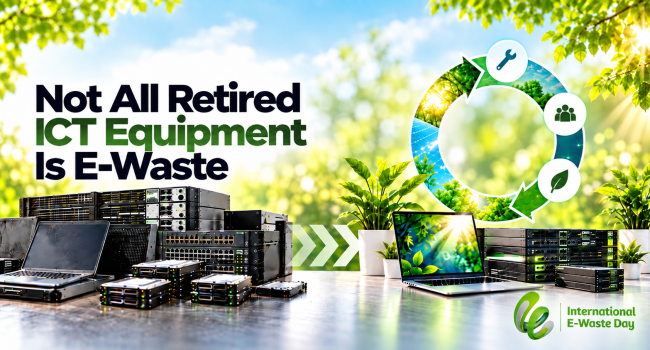
Across Kenya’s growing digital economy, organisations are upgrading ICT hardware faster than ever – from laptops and servers to routers, printers, and data-centre equipment. But for every upgrade, dozens of devices still hold functional life and economic value that often goes untapped.
IT Asset Redeployment is the bridge between disposal and sustainability. It ensures that functional or repairable ICT equipment is refurbished, tested, and reintegrated – either within your organisation or through responsible resale and donation.
At RefHub, we call this the “second life” of technology. It’s a practical path that combines financial efficiency, environmental stewardship, and social impact in technology use and reuse.
What is IT Asset Redeployment?
IT Asset Redeployment refers to the process of restoring, repurposing, and reallocating ICT equipment so that it can continue serving a productive role rather than being prematurely discarded. It involves four key elements:
- Refurbishment – repairing, cleaning, and upgrading devices to meet functional or performance standards.
- Testing & Quality Assurance – ensuring devices are reliable, secure, and ready for redeployment.
- Reallocation – redistributing equipment to new users, departments, or external beneficiaries.
- Value Recovery – remarketing surplus assets to recover capital or fund sustainability initiatives.
RefHub’s approach integrates these elements into a single controlled cycle, backed by asset tracking, data sanitisation, and ESG reporting.
Why IT Asset Redeployment Matters
Most ICT equipment is retired long before its true potential is exhausted. Yet every device sitting idle in a store room represents not just sunk capital, but also an opportunity to extend its life, reduce environmental waste, and recover value. IT redeployment matters because it transforms this overlooked stage of the IT lifecycle into a strategic advantage.
By refurbishing, repairing, and reallocating functional assets, organisations can:
1. Extend the Useful Life of ICT Assets – Most business-class devices are built to last far beyond the typical 3- to 5-year refresh cycle. RefHub’s refurbishment program restores these assets to Grade A performance, reducing unnecessary e-waste.
2. Reduce Total Cost of Ownership (TCO) – Redeployment saves procurement costs by allowing organisations to reuse existing equipment rather than buying new. It also defers capital expenditure while maintaining productivity.
3. Support Environmental Sustainability – Every refurbished device saves an average of 250 kg of CO₂ and several kilograms of raw materials that would have been extracted to build a new one. By redeploying instead of discarding, organisations directly contribute to Kenya’s circular economy and SDG 12 (Responsible Consumption and Production).
4. Protect Data and Ensure Compliance – RefHub integrates data sanitisation into all refurbishment workflows, ensuring redeployed or donated devices are completely free of sensitive information — in full compliance with the Data Protection Act (2019).
5. Promote Social Impact – Through our Circular Marketplace and Digital Inclusion Programmes, RefHub channels refurbished ICT devices to schools, NGOs, and social enterprises — expanding access to affordable technology across Kenya.
5 Steps of RefHub IT Asset Redeployment Framework
The RefHub IT redeployment model combines technical excellence, traceability, and impact measurement. It involves five key steps:
Step 1: Asset Evaluation
- Audit and assess retired or surplus ICT equipment.
- Identify repairable, reusable, or upgradeable units.
- Generate detailed asset condition reports and residual-value estimates.
Step 2: Data Sanitisation
- Erase all sensitive data using DoD 5220.22-M and NIST 800-88 standards.
- Issue Certificates of Data Erasure for each device.
Step 3: Refurbishment & Repair
- Hardware cleaning, component replacement, BIOS/firmware updates.
- Stress testing and quality control to ensure reliability.
- Cosmetic restoration for commercial-grade presentation.
Step 4: Redeployment Pathways
We categorize assets into three redeployment streams:
- Internal Reuse – redeploy to other branches or departments.
- Circular Resale – remarket through RefHub’s resale channels to recover capital.
- Social Donation – allocate refurbished devices to schools or community ICT hubs.
Step 5: Certification & Reporting
- Detailed Refurbishment Certificates, Asset Redeployment Logs, and Environmental Impact Reports.
- Quantify CO₂ savings, landfill diversion, and economic value recovered.
IT Asset Redeployment vs. Recycling: The Sustainability Hierarchy
While recycling plays an important role in managing e-waste, redeployment delivers far greater sustainability returns. How?
Recycling breaks materials down for reuse, but redeployment keeps the device itself in circulation, saving energy, resources, and carbon emissions that would otherwise go into manufacturing new equipment.
Put simply, IT Asset redeployment preserves the most value with the least environmental cost, making it the top tier of the sustainability hierarchy.
Take a look at this comparison table:
| Stage | Description | Environmental Impact |
| Reuse / Redeployment | Extends the useful life of assets with minimal energy input. | Highest positive impact |
| Refurbishment / Repair | Restores performance and prevents premature waste generation. | Strong circular benefit |
| Recycling | Breaks down materials for reuse; energy-intensive but necessary for end-of-life items. | Moderate benefit |
| Disposal | Landfilling or incineration of e-waste. | Severe environmental cost |
Redeployment sits above recycling in the waste hierarchy. It delivers the greatest sustainability ROI by conserving resources while retaining equipment functionality.
The Kenyan Context
Kenya generates an estimated 53,000 tonnes of e-waste annually, yet less than 15% of it is formally recycled or reused. The government, through NEMA, is strengthening Extended Producer Responsibility (EPR) regulations, requiring importers and users to manage ICT end-of-life responsibly.
RefHub Limited is aligned with these frameworks and supports clients by:
- Offering NEMA-compliant refurbishment and collection services.
- Documenting material recovery and reuse metrics for EPR compliance.
- Partnering with certified recyclers for non-redeployable components.
- Supporting public-sector institutions under the Public Procurement and Asset Disposal Act (2015) to dispose of assets transparently and reuse wherever possible.
IT Asset Redeployment Use Cases in Kenya
There are different cases IT Asset Redeployment in various industries. In Kenya, some of these include:
1. Corporate ICT Refresh Cycles – Kenyan corporates upgrade their staff laptops every three years. RefHub refurbishes the outgoing units and redeploys them to field offices — reducing procurement costs by 40 %.
2. Banking Sector Equipment Renewal – A regional bank consolidates branches. RefHub audits, wipes, and repairs decommissioned servers and POS terminals, redeploying functional units to rural branches.
3. Public-Sector Digital Literacy Projects – RefHub partners with county governments to donate refurbished PCs to youth innovation centres, supporting local digital-skills development.
4. Data-Centre Hardware Reuse – RefHub tests and recertifies decommissioned enterprise-grade servers and switches, making them available for SMEs and startups through its Circular Marketplace.
How to Build an IT Asset Redeployment Program with RefHub
RefHub is well positioned to help you with your IT Asset Redeployment. To start the progam, here is what to do:
1. Schedule a Site Audit – Our team of qualified experts inspects your ICT inventory and identifies redeployment candidates.
2. Develop a Redeployment Policy – Define eligibility, data-wiping standards, and approval workflows.
3. Set Internal Reuse Goals – e.g., 25 % of devices to be redeployed annually.
4. Track and Report – Use RefHub’s redeployment dashboard to monitor savings and environmental impact.
5. Promote Circular Culture – Encourage staff to support reuse, repair, and responsible tech lifecycle management.
Measuring the Impact
Sustainability is only meaningful when it can be measured. RefHub tracks every redeployment project with clear metrics that quantify environmental, economic, and social outcomes by providing measurable Key Performance Indicators (KPIs) for every redeployment engagement:
| Metric | Description |
| Redeployment Rate (%) | Ratio of refurbished to total retired assets |
| Value Recovered (KES) | Total resale or reuse value gained |
| CO₂ Avoided (kg) | Emissions prevented through reuse |
| E-waste Diverted (kg) | Materials prevented from landfill |
| Social Devices Donated | Refurbished assets channelled to social causes |
From the number of devices refurbished to the kilograms of eWaste diverted and CO₂ emissions avoided, these indicators turn responsible IT management into tangible results, empowering organizations to report IT circularity within ESG, CSR, and EPR frameworks.
The Bigger Picture — Building Kenya’s Circular ICT Future
By embedding refurbishment and redeployment into ICT lifecycle management, Kenyan organisations can simultaneously cut costs, comply with e-waste regulations, protect data and advance national sustainability goals.
RefHub stands at the centre of this transition — linking corporations, recyclers, and social programmes to build a truly circular ICT ecosystem.
Book a free ITAD Assessment with RefHub today