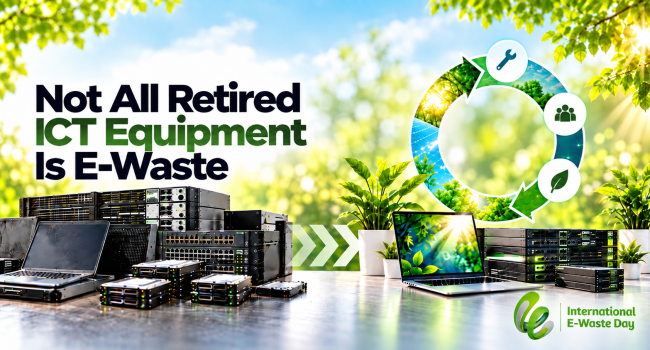
There is a silent risk behind every electronic or technology device.
Every business eventually retires its technology; laptops are replaced, servers decommissioned, disks stored “just in case.”
However, behind those metal casings lies a silent threat: data that never truly dies. Even after a “delete” command or a quick format, fragments of customer files, financial records, or intellectual property often remain recoverable.
In Kenya’s digital economy, where cybercrime, data protection laws, and ESG commitments converge, how organisations handle retired IT equipment defines their credibility, compliance, and conscience.
This paves way for Certified Data Destruction: a disciplined, traceable process that ensures sensitive information is irreversibly erased, while the underlying hardware is processed responsibly for reuse or recycling.
Beyond Deletion: The Science of True Data Destruction
Deleting files is not destruction. On most storage media, deletion merely removes a file’s reference, not its content. Any data recovery software can resurrect that information in seconds.
Certified destruction goes far deeper. It employs verified overwriting algorithms, magnetic degaussing, or mechanical shredding to render all traces permanently inaccessible. The destruction process is audited, documented, and certified, creating a verifiable trail from pickup to final recycling.
At RefHub, this isn’t a checkbox exercise but a security discipline performed under controlled conditions, ensuring that no byte of sensitive data ever escapes containment.
The Dual Imperative: Security and Sustainability
Most organisations see data destruction purely as a security measure. RefHub reframes it as a dual imperative – protecting information integrity while upholding environmental responsibility.
In traditional disposal, data-bearing devices often end up in informal scrapyards, where untrained handlers strip valuable metals without regard for toxicity or confidentiality.
The result?
- Leaked corporate or personal data.
- Contaminated soil and waterways from heavy metals.
- Breach of Kenya’s Data Protection Act (2019) and Environmental Management and Co-ordination Act (EMCA, Cap 387).
RefHub’s model ensures that every destroyed drive becomes a recycled resource rather than a liability. Shredded metals, plastics, and circuit boards are channelled into licensed recovery networks, closing the loop between cybersecurity and sustainability.
Inside RefHub’s Certified Data Destruction Ecosystem
Rather than a linear process, RefHub operates a closed-loop ecosystem built around transparency, control, and reuse. This ecosystem ensures that security and sustainability are inseparable – the end of data is the beginning of material reuse. How?
Secure Custody – Collection teams operate under secure logistics and transport protocols, ensuring each device is logged from the moment it leaves your premises.
Controlled Access – RefHub’s facility uses surveillance, restricted zones, and chain-of-custody checkpoints. Only certified technicians handle data-bearing devices.
Dual-Mode Destruction – Depending on reuse potential:
- Logical Erasure: Multi-pass overwriting per NIST 800-88 standards for equipment intended for redeployment.
- Physical Shredding: Drives, SSDs, and tapes are mechanically pulverised beyond recovery.
Digital Audit Trail – Each action — collection, erasure, destruction, recycling — is digitally recorded and linked to a Certificate of Data Destruction issued to the client.
Material Reclamation – Post-destruction remnants enter RefHub’s Circular Recovery Stream, where metals and plastics are separated and delivered to NEMA-licensed recyclers for re-entry into manufacturing.
Kenya’s Legal and Ethical Landscape
In Kenya, certified data destruction is a legal requirement and an ethical expectation.
- The Data Protection Act (2019) obligates organisations to ensure personal data is permanently destroyed when no longer needed.
- NEMA’s E-Waste Guidelines (2013) and EPR Regulations (2022) mandate environmentally responsible treatment of all ICT waste.
- Public Procurement and Asset Disposal Act (2015) demands accountable handling of government ICT assets.
Failing to comply exposes organisations to regulatory penalties, reputational damage, and potential litigation. RefHub bridges the gap between compliance and execution — translating policy into a verifiable process.
What Certification Really Means
Data destruction certification isn’t just paperwork but proof of integrity. RefHub’s certificates carry:
- Unique device serials and batch numbers.
- Date, method and technician ID.
- Reference to destruction standards used (DoD 5220.22-M / NIST 800-88).
- Environmental handling declaration.
Each certificate forms part of an audit trail you can present during reporting reviews — evidence that your organisation safeguards both data and the environment.
The Hidden Value in Responsible Destruction
Ironically, destroying data can create value. By securely erasing and refurbishing reusable devices, organisations recover hardware for resale, donation, or redeployment. By recycling destroyed media responsibly, they generate secondary raw materials and quantifiable carbon savings.
RefHub provides detailed analytics showing:
- Volume of data-bearing assets processed.
- CO₂ emissions avoided through recycling.
- Kilograms of e-waste diverted from landfills.
- Revenue or value recovered through reuse channels.
This way, security becomes a sustainability asset, not just a cost centre.
Towards a Circular Data Future
Kenya’s digital transformation demands infrastructure that is not only secure but sustainable. Certified Data Destruction by RefHub demonstrates that the two can coexist: protecting sensitive information while regenerating material value. The journey doesn’t end when the data dies – it continues as recycled metals, refurbished devices, and measurable environmental gains.
With RefHub, you are protecting data, preserving the planet, and powering a circular ICT future.
Book a Secure Data Destruction Audit